
Client
A regional passenger transport operator engaged us to assess entry into Bahrain through employee transportation, institutional mobility services, and contracted shuttle operations.
The company wanted to establish a scalable operating model without committing excessive fleet capacity before customer demand had been validated.
Issues
The original business plan assumed that Bahrain's compact geography would allow vehicles to serve multiple areas efficiently.
In practice, potential customers had different working hours, pickup patterns, vehicle requirements, contract structures, and service expectations. Management also lacked visibility on dead mileage, corridor economics, fleet utilization, and the potential to combine multiple contracts within the same operating schedule.
Solution
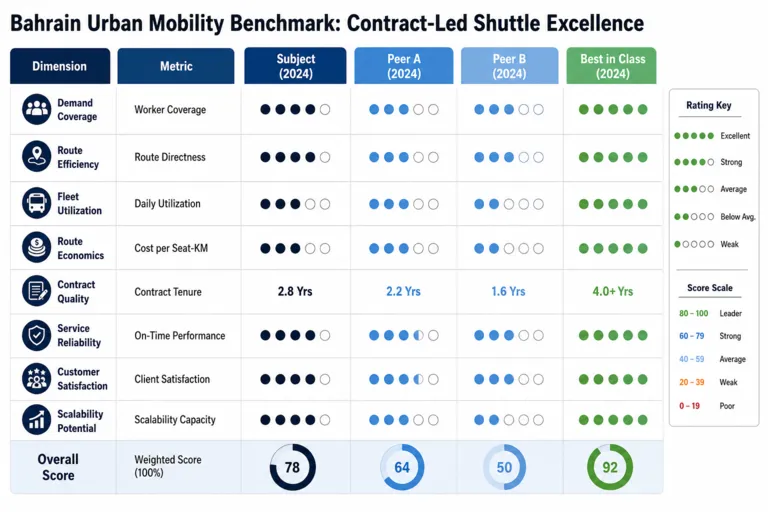
We developed a transport market and route strategy combining customer research, corridor analysis, competitor benchmarking, route modelling, fleet economics, and contract segmentation.
Approach
Potential demand was mapped across Manama, Muharraq, Isa Town, Riffa, and major employment areas.
Routes were analyzed by passenger volumes, departure times, vehicle size, journey duration, return utilization, and daily operating kilometres. We then compared dedicated contracts with shared shuttle and flexible transport models.
Recommendations
We recommended entering the market through contracted B2B transportation rather than launching open commercial routes.
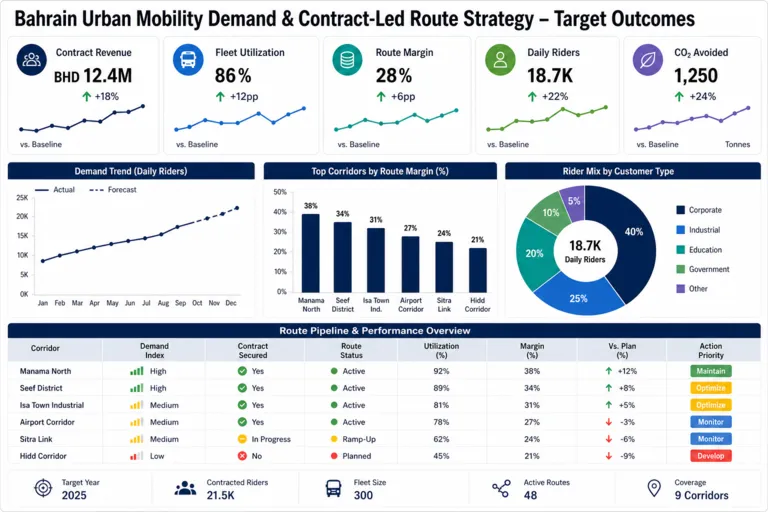
Three priority corridor groups were developed around Manama, Muharraq, and the Southern Governorate, with schedules designed to combine complementary morning and afternoon demand and reduce non-revenue vehicle movement.
Engagement ROI
The proposed network improved modeled average vehicle load factors by 10 percentage points and reduced dead mileage by 14%.
Better route pairing lowered modeled operating cost per passenger by 8%, while the contract-led rollout allowed the operator to launch with approximately 20% fewer vehicles than originally planned.