
Client
A European manufacturer of specialist building materials engaged us to assess Bahrain as part of its wider GCC expansion. The company wanted to understand local demand, identify priority customer segments, and determine whether direct sales or a distribution-led model offered the strongest route to market.
Issues
The client had limited visibility on the size of the addressable market and faced established regional and local competitors. Demand was fragmented across contractors, developers, consultants, distributors, and industrial customers, while product specification and supplier relationships played an important role in purchasing decisions.
Management also needed to understand how opportunities in Manama differed from industrial demand around Hidd and Sitra, and whether Bahrain should be approached as a standalone market or as part of a broader GCC commercial strategy.
Solution
We developed a market entry strategy combining market sizing, customer segmentation, competitor benchmarking, pricing analysis, and distributor assessment. The work focused on identifying where the client's technical proposition could compete effectively without requiring significant upfront investment.
Approach
We mapped demand across construction, infrastructure, refurbishment, and industrial applications and assessed the purchasing criteria of contractors, consultants, distributors, and end users.
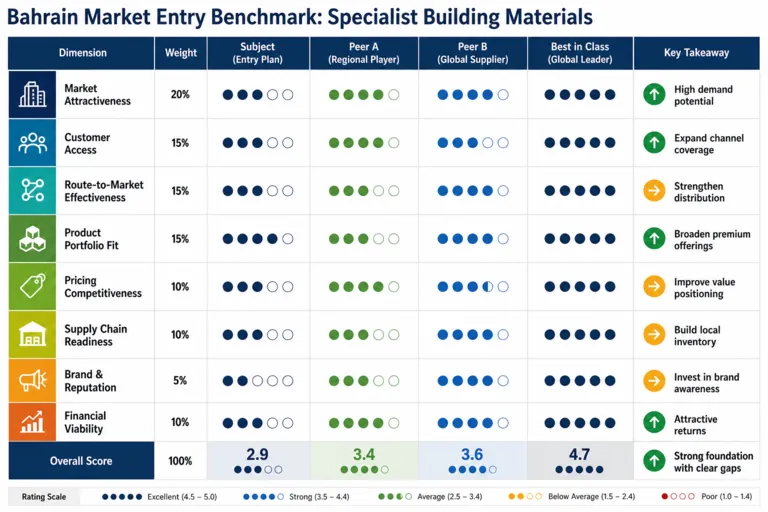
Competitors were benchmarked across product portfolio, pricing, technical positioning, project references, customer coverage, and distribution capabilities. We also compared direct sales, exclusive distribution, multi-distributor, and hybrid entry models to determine the most appropriate structure for Bahrain.
Recommendations
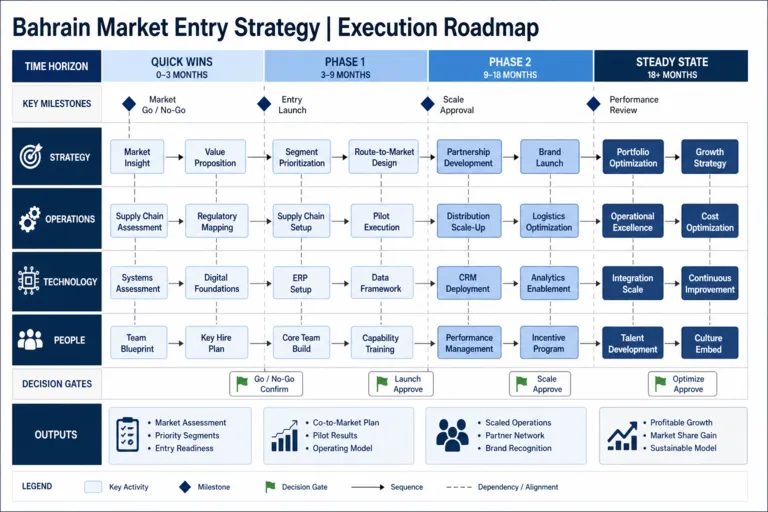
We recommended a phased market entry focused initially on a defined group of contractors, consultants, and industrial accounts supported by a specialist local distributor.
Technical specification and project-based business development were prioritized ahead of broad distribution. Local inventory would remain limited during the initial phase, with stock levels increasing only as repeat demand and project visibility improved.
Engagement ROI
The strategy narrowed the client's initial market universe to 24 priority accounts and identified three qualified distribution partners.
The recommended model reduced estimated first-year market-entry investment by approximately 32% compared with the client's original direct-entry plan and shortened the expected commercial launch timeline by around four months.