
Client
A regional industrial group engaged us to conduct commercial due diligence on a Bahrain-based manufacturer serving construction, infrastructure, and industrial customers.
The target operated from an established industrial location and had developed a significant base of recurring B2B accounts across the Kingdom.
Issues
The investment thesis assumed continued market growth, resilient margins, higher capacity utilization, and expansion into adjacent product categories.
Management needed independent validation of market demand, customer concentration, competitive positioning, pricing sustainability, production capacity, and the achievability of the target's growth forecasts.
Solution
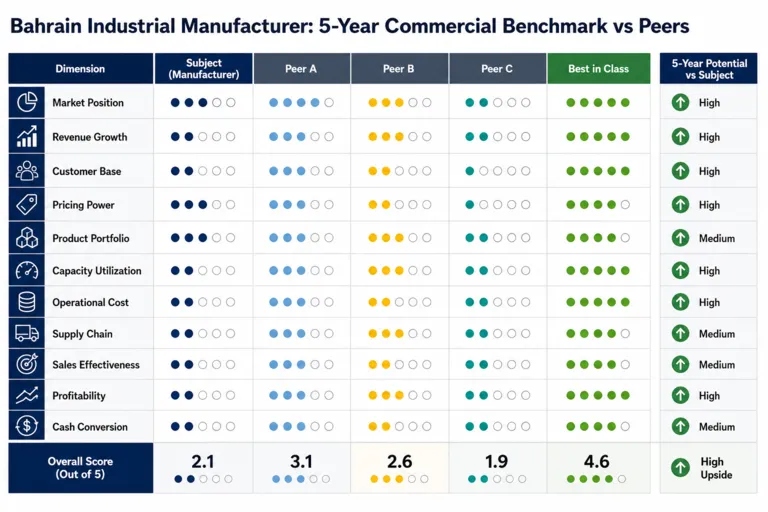
We conducted a commercial due diligence covering market attractiveness, demand outlook, competitor positioning, customer concentration, pricing, capacity utilization, growth opportunities, and strategic fit.
Approach
We analyzed the target's revenue and customer base alongside market demand across contractors, distributors, infrastructure projects, and industrial buyers.
Competitors operating across Hidd, Sitra, Ma'ameer, and other industrial areas were benchmarked by product range, capacity, price positioning, technical capabilities, and customer relationships.
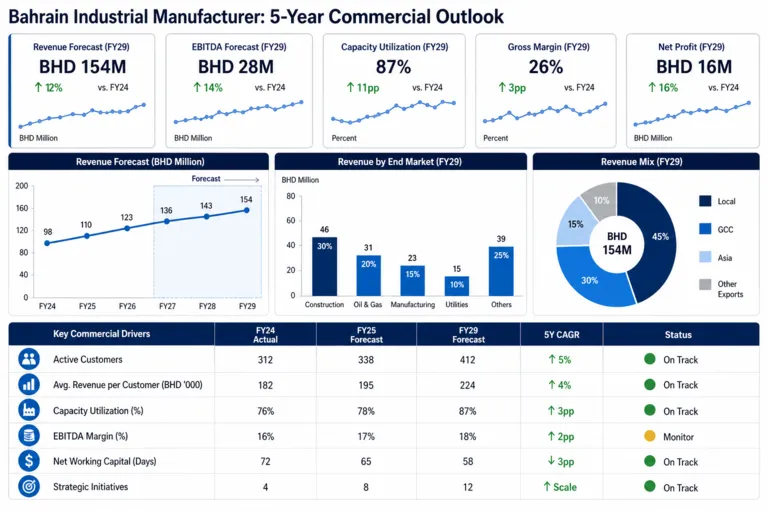
Management's forecasts were then tested against market evidence, historical account performance, capacity requirements, and competitive conditions.
Recommendations
We recommended proceeding with the transaction while revising the original investment case.
The base-case growth assumption was moderated, major capacity expansion was linked to higher utilization thresholds, and management was advised to focus first on protecting core accounts and developing selected higher-margin product categories.
Regional export opportunities were retained as upside rather than embedded in the base-case valuation.
Engagement ROI
The diligence resulted in the investor reducing the target's base-case five-year revenue growth assumption from 11% to 7% annually and supported a 9% revision to the proposed valuation.
We also identified three value-creation initiatives with the potential to improve EBITDA margin by approximately 2.5 percentage points over three years, providing a more disciplined basis for negotiation and post-acquisition planning.