
Client
A regional logistics operator engaged us to redesign its temperature-controlled warehousing and distribution model in Bahrain.
The business served food importers, distributors, restaurants, healthcare customers, and pharmaceutical supply chains from facilities in and around Hidd.
Issues
The network had expanded incrementally as demand increased, resulting in uneven cold-storage utilization, fragmented delivery routes, multiple product-handling points, and limited visibility on the economics of smaller customer orders.
Food and pharmaceutical workflows also shared infrastructure that was becoming increasingly difficult to manage as volumes and service requirements increased.
Solution
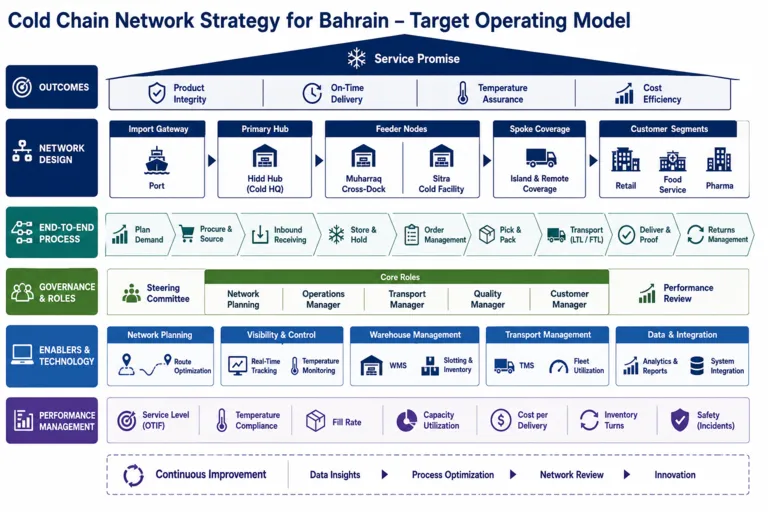
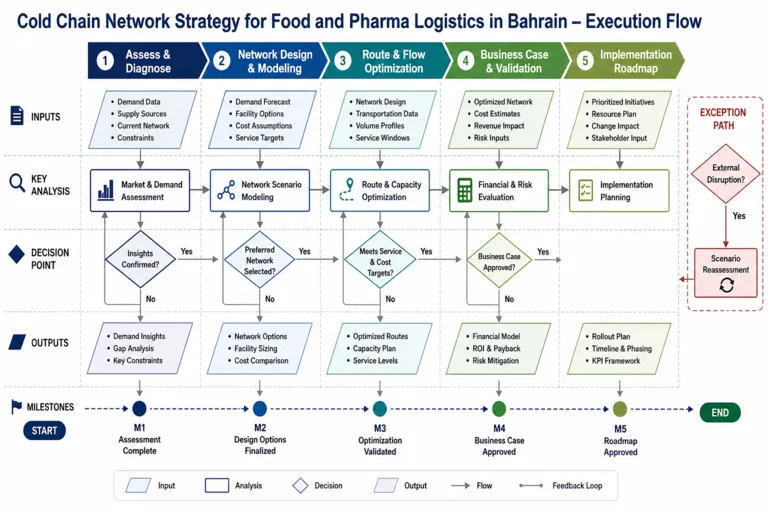
We developed an integrated cold chain strategy combining demand analysis, warehouse capacity modelling, customer segmentation, route economics, temperature-control requirements, and future infrastructure planning.
Approach
We mapped product flows from receiving through storage, picking, dispatch, and final delivery.
Customer demand across Manama, Muharraq, Riffa, and surrounding commercial areas was analyzed alongside order frequency, delivery windows, vehicle utilization, storage requirements, and temperature profiles.
Several warehouse and delivery-network scenarios were then modeled to determine the most efficient operating structure.
Recommendations
We recommended consolidating core cold-storage activity in Hidd while separating operating procedures for food and pharmaceutical products.
Smaller deliveries were grouped into scheduled route windows, while additional warehouse capacity would be triggered by predefined utilization thresholds rather than forecast demand alone.
Engagement ROI
The redesigned network increased modeled cold-storage utilization from 68% to 81% and reduced delivery kilometres per order by approximately 13%.
Estimated distribution cost per shipment fell by 9%, while the phased capacity plan deferred approximately 18 months of planned warehouse expansion, reducing near-term capital requirements.